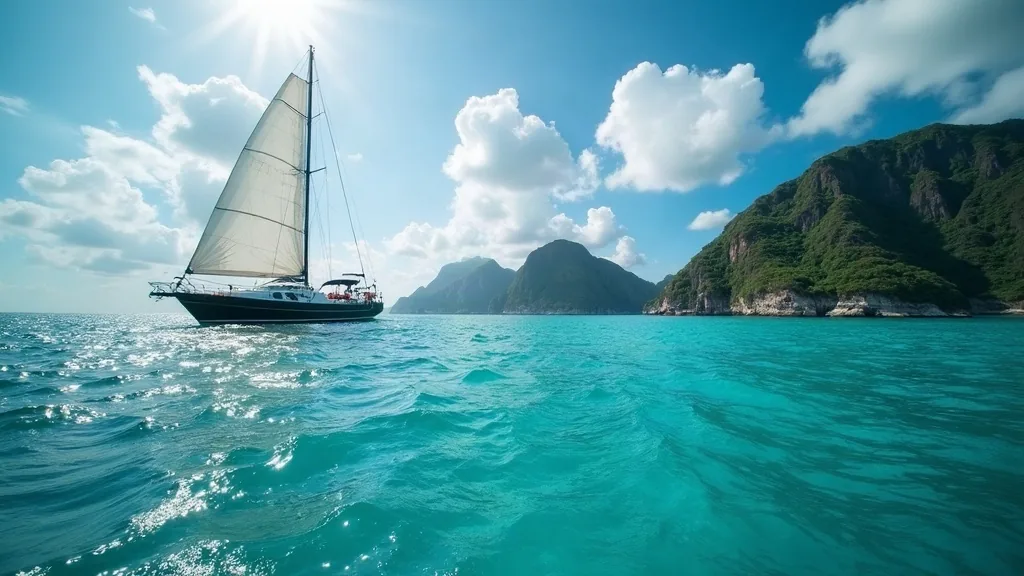
Misool is the best reef in Raja Ampat and the leg most likely to be lost to weather, so plan it as an expedition rather than an excursion: full tanks and water, a fuel reserve that covers a multi-day weather delay, a genuine turn-back point agreed before departure, and no promise to guests that it will happen. The run south from Waisai takes several hours, shoreside support at the far end is minimal, and during the southeast period the sea state in between frequently closes the door.
Why the leg is different
The core cruising zone around the Dampier Strait is forgiving. You are within a few hours of Waisai, the ferry link to Sorong is short, dive operators are constantly present, and if something breaks the recovery path is obvious.
Misool inverts all of that. It sits well to the south, the passage crosses more open water, the settlements are smaller, the resorts are few and private, and the nearest meaningful support is back where you started. Nothing about this makes it inadvisable — it makes it a leg that has to be planned rather than drifted into.
The fuel arithmetic
Because there is no bunkering of consequence in the islands, the fuel plan governs the itinerary. Build it explicitly rather than by feel:
| Component | Planning note |
|---|---|
| Passage down | Calculate at a realistic speed against likely sea state, not flat-water cruise speed. |
| Days on station | Repositioning between Misool sites, plus generator load for the whole period. This is often larger than the passage itself. |
| Passage back | Assume it may be against the weather that closed the window. |
| Weather delay reserve | A genuine multi-day allowance. This is the item crews cut and the item that matters. |
| Absolute reserve | Untouchable. If the plan needs it, the plan is wrong. |
Do the same arithmetic for water if the watermaker is your only source, which it should be — see facilities and supply. And do it for provisions, remembering that Misool is not where you top up.
Reading the window
During the southeast period, broadly June to September, sustained trade wind and the sea it builds come onto south-facing coasts and across the ground you have to cross. The leg is frequently uncomfortable and sometimes not sensible. During the more settled period, broadly October to April, and especially in the transitional months, windows are far more common.
A window is not a forecast of good weather; it is a forecast of a period long enough to get there, work, and get back — or at least to get there and be comfortable staying longer than intended. That last condition is the one people forget. If the forecast supports the passage down but nothing beyond it, you are not looking at a window; you are looking at a commitment to being stuck.
The turn-back point
Agree it before departure, in writing, on the plan: a time and a position at which, if conditions or vessel state are not what was expected, the vessel turns round without further discussion. Nominate who makes the call and make it binding.
The reason to formalise this is that the pressure to continue always builds during the passage. Guests are aboard, expectations were set, the sea is bad but not that bad, and it is only another two hours. Decisions made under that pressure are worse than decisions made the day before in the saloon.
What Misool gives you
It is worth the planning. The southern group has extraordinary reef, dramatic karst geography, and a fraction of the traffic of the Dampier Strait. Vessels that get there in a good window generally describe it as the reason they came.
Practically, the working pattern is anchor and mooring as everywhere else — see the anchorage page — with an added emphasis on self-sufficiency and on shore access being arranged rather than assumed. Some of the most important conservation work in Raja Ampat has happened in this area through no-take zones agreed with local communities, and the reef quality reflects it. Respect the closures absolutely.
Setting expectations with guests
The correct contract with guests is: these are the zones we may work, this is the standard of the diving and the scenery, and the specific sequence is decided on the water according to weather. Never sell Misool as a fixed item on a fixed date.
Charter operators who have run this region for years all converge on the same language, and it is not evasion — it is the only honest description of what can be delivered. Guests who are told this at booking are delighted when the leg happens. Guests who were promised Misool and get the Dampier Strait feel short-changed by an itinerary that was in fact excellent.
For how the Misool leg fits a full season alongside the northern islands, see the cruising guide, and send the vessel’s range and window to the desk if you want the leg assessed against real numbers.
What to carry specifically for this leg
Beyond the standing spares inventory, three items repay their stowage space on the southern run. Extra tender fuel, because almost everything at Misool is reached by tender and the distances between anchorage and site are longer than the chart suggests. Extra fresh water beyond the watermaker’s daily output, as a buffer against a membrane problem several hours from anywhere. And a properly stocked medical kit rather than the coastal one, because the evacuation path from Misool begins with a long passage back toward Waisai before it reaches anything resembling medical care — the constraint set out on the facilities page.
Waste and behaviour in the southern group
Misool’s reef quality is the direct result of community-led no-take zones that local people chose to accept and continue to enforce. A visiting yacht is a guest in something that was built at real cost by others. Respect the closures absolutely, carry every scrap of waste back out as described in waste management in a marine protected area, and make contact before landing anywhere inhabited. Vessels that do this are welcome in the southern group. Vessels that do not are noticed quickly, because there is very little traffic and everyone knows who is there.
Frequently asked questions
How long does it take to sail from Waisai to Misool?
Several hours of steaming depending on the vessel’s speed and the sea state, across more open water than the core Dampier Strait cruising zone. It should be planned at a realistic speed against likely conditions rather than at flat-water cruise speed.
Is there fuel or support at Misool?
Shoreside support in the Misool group is minimal and there is no bunkering of consequence. The leg should be planned as self-sufficient, with fuel, water, provisions and spares carried for the whole period plus a genuine multi-day weather delay reserve.
Talk to the berthing desk
Raja Ampat rewards vessels that arrive with a plan. Share your LOA, draft, arrival window and intended islands, and we will answer with what is realistically available. Quotations in USD.