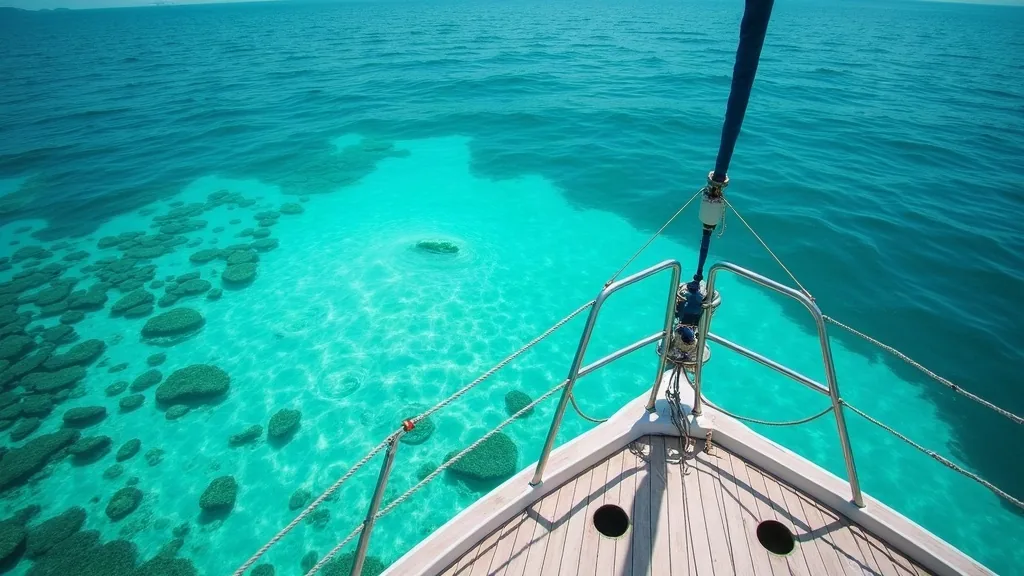
Anchoring in Raja Ampat is a visual skill before it is a ground-tackle skill: you find a clean sand patch with your eyes, in good light, with a lookout up high, then you drop on it and confirm the set. Coral holds badly and must not be anchored on, and chart data in eastern Indonesia is not detailed enough to substitute for looking. Crews that adopt the visual routine anchor safely here for years. Crews that drop on a depth sounder reading eventually drag over reef.
Light is the first input
You cannot read the bottom without light, and light in the tropics is directional. The workable window is roughly mid-morning to mid-afternoon with the sun high and behind you as you look. Approaching a new anchorage into a low sun turns the surface into a mirror and hides everything beneath it.
This single fact should shape the day’s schedule more than any other. Plan legs so that arrival at an unfamiliar anchorage falls in the middle of the day, not at dusk. If a passage runs long and you will arrive late, the right decision is to stop somewhere known, or to stand off and enter in the morning. Arriving tired into an unlit reef approach at last light is how good crews lose hulls.
Get a lookout high and give them authority
Height transforms what you can see through water. A lookout on the coachroof sees more than one on the bow; one in the rigging or on a flybridge sees more again. Give them polarised sunglasses, a radio or a clear set of hand signals, and — this matters — the authority to stop the vessel.
Agree the signals before you enter: stop, back, left, right, and a distinct signal for coral ahead. The most common failure is a lookout who sees something and hesitates because they are not sure they are allowed to call it. Brief that out of the crew on day one.
Reading colour
| What you see | What it usually means |
|---|---|
| Pale, even, cream or white | Sand. Your target. |
| Dark brown, mottled, textured | Coral, rock or heavy weed. Do not anchor. |
| Dark green-brown, uniform | Seagrass. Holding is unreliable and the habitat is protected in places. |
| Deep blue with no detail | Too deep to read; you are outside the shelf. |
| Sharp colour boundary | Shelf edge. Depth changes very fast at these. |
Colour reading takes practice, and it is confounded by cloud shadow, which looks alarmingly like a coral head. When in doubt, circle and look again from a different angle rather than guessing.
The drop and the set
Once you have identified a patch, size it honestly against the swing you will need. A sand patch big enough to drop in but not big enough to swing in is not an anchorage — the chain will sweep coral all night even if the anchor itself stays put.
Approach slowly, stop over the patch, and lower rather than let the anchor run. Lay the chain out as you fall back so it lies along the sand rather than piling. Then back down properly — enough load to be sure the anchor is set, held long enough to be sure it is not still moving — and take a transit ashore to confirm you are not creeping.
Then get in the water and look at it, or send a mask down from the tender. Thirty seconds of visual confirmation tells you what an hour of instrument watching will not: whether the anchor is buried in sand or sitting on a rock ledge looking convincing.
Verifying the swing
Walk the circle before you settle. In the Raja Ampat passages the vessel will frequently lie to tidal stream rather than wind, and the stream reverses, so the circle has to be clear in every direction — not just the one you are lying in now.
Check it at the state of tide that matters. A chain that clears a coral head at high water may not at low, and the difference in this region is enough to matter. If the swing cannot be made clear, either use a mooring where a sound one exists, or move.
Chain, scope and coral
Generous scope holds better and lies flatter, which is good, but it also sweeps a larger circle, which over coral is bad. Where the patch is small, the practical compromise is a shorter scope with the engine and crew available, and a firm intention to move rather than ride out anything serious in a marginal spot.
Some vessels use a float or buoyed chain arrangement to lift the catenary clear of an obstruction. It has a place, but it changes the holding characteristics and should be used deliberately by crews who have practised it, not improvised at dusk in an unfamiliar bay.
Recovering without damage
Come up over the anchor rather than pulling it out sideways. If it is fouled, do not winch harder — send someone down, or use a trip line if one was rigged. Dragging a fouled anchor out of coral does exactly the damage the whole routine exists to prevent, and in a marine protected area it is the kind of thing that gets noticed and reported.
Where a site is tight enough that recovery looks difficult, that is information about whether you should have anchored there. The wider planning logic is on the anchorage page and the seasonal sequencing on the cruising guide.
Frequently asked questions
What time of day is best for anchoring in Raja Ampat?
Mid-morning to mid-afternoon, with the sun high and behind you. Low sun turns the surface into a mirror and hides the bottom, so unfamiliar anchorages should not be entered at dusk. Plan passages so arrivals fall in the middle of the day.
Can you anchor on coral in Raja Ampat?
No. Coral holds badly and anchoring on it causes lasting damage in a marine protected area where anchoring restrictions apply. The correct target is a clean sand patch large enough for the full swinging circle, identified visually before the anchor is lowered.
Once the hook is down, the test comes after dark — night squalls and the anchorage that survives.
Talk to the berthing desk
Raja Ampat rewards vessels that arrive with a plan. Share your LOA, draft, arrival window and intended islands, and we will answer with what is realistically available. Quotations in USD.