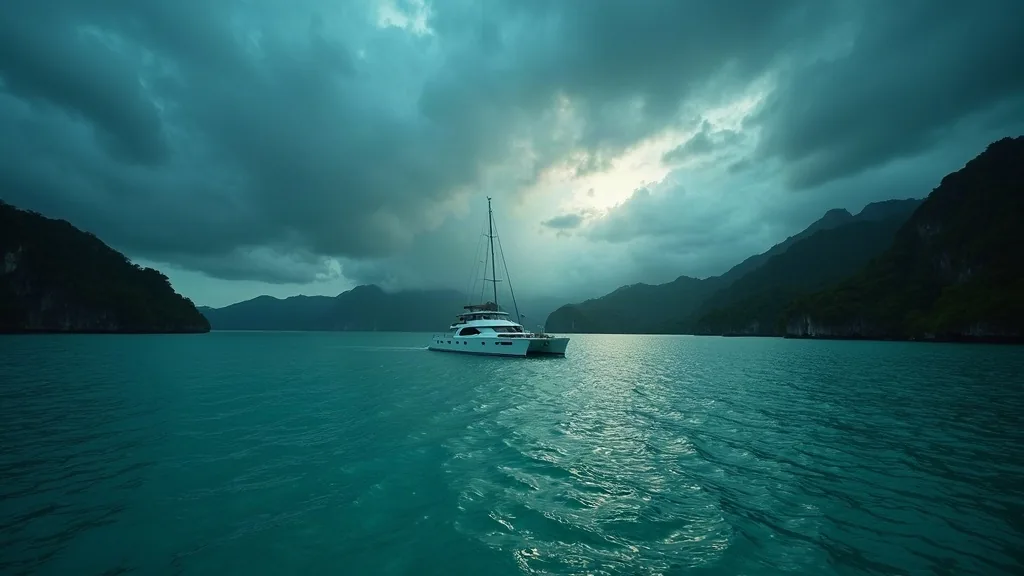
The anchorage that survives a Raja Ampat night is the one that is tenable in every direction, not the one that is comfortable in tonight’s forecast wind. Equatorial squalls form fast, arrive at night, and bring a rapid wind shift with a short violent burst. An anchorage protected only from the current quarter becomes a lee shore in minutes. Choose for the shift, set the vessel up before dark, and accept that the price of a good night is sometimes a less scenic bay.
What an equatorial squall actually does
Raja Ampat sits close to the equator, in warm water, with high humidity and substantial island topography. That combination generates convective activity year-round, independent of monsoon season. A cell builds through the afternoon and evening, and when it collapses it dumps cold air outward as a gust front.
The practical characteristics are: sudden onset, a wind speed far above the ambient, a direction determined by where the cell is rather than by the prevailing pattern, heavy rain that destroys visibility, and a duration usually measured in tens of minutes rather than hours. That last point is what saves people — but only if the vessel is still where it was when the squall arrived.
Choosing for the shift, not the forecast
The instinct is to tuck into the lee of the prevailing wind. In a squall-driven environment that instinct is a trap, because the prevailing wind is not what will hit you at 0230.
Look at a candidate anchorage and ask a different question: if the wind came hard from each of the four quadrants in turn, where would the vessel end up? A bay with a wide open sector, or with a shoreline close astern in any direction, fails that test regardless of the forecast. A bay with moderate protection all round, adequate swinging room and deep water to escape into passes it.
This is also an argument for anchoring slightly further out than the most sheltered spot. The extra distance from the shore is the margin that buys time when the anchor takes a shock load in a direction it was not set for.
What to do before dark
| Before sunset | Why |
|---|---|
| Verify the anchor visually and back down again | A set that was fine in light airs may not be. Confirm it while you can see. |
| Walk the swing circle for all directions | The squall will pick the direction you did not check. |
| Set a drag alarm with a realistic radius | An alarm set too wide is an alarm that fires when you are already on the reef. |
| Clear the decks and secure awnings | Windage in a squall is a real load, and loose gear becomes projectiles. |
| Recover or shorten the tender | A tender on a long painter in a squall fouls the rudder or the prop. |
| Brief the watch and plan the escape route | Deciding where to go while it is happening is too late. |
| Note a deep-water exit bearing | Visibility goes to nothing in the rain. You need a number, not a view. |
During the squall
Start the engine early — before it is needed, not when it is. Having propulsion available and warm converts a crisis into an inconvenience. Put someone competent on watch with the radar and the chartplotter, and keep the crew off the foredeck unless there is a reason.
Resist the urge to move immediately. In heavy rain with no visibility, motoring around a reef-strewn bay is more dangerous than holding position on a set anchor with the engine assisting. Move only if you are dragging or if the vessel is being driven onto something — and move on the bearing you noted before dark.
If you are on a conservation mooring, remember that its rating was determined for normal loads. A squall load on an undersized mooring is exactly when it fails, which is why an anchor watch on a mooring is not paranoia.
Season does not exempt you
The monsoon pattern described on the anchorage page tells you where the swell and sustained wind will come from across a season. It tells you almost nothing about squalls, which occur throughout the year. A crew that plans the season correctly and then relaxes about nightly conditions has solved half the problem.
This is the reason experienced skippers here are conservative about anchorage choice in a way that can look excessive to guests. The scenic bay with the perfect view and one open quadrant is a lunch stop. The slightly duller bay with all-round protection is where the vessel spends the night.
The margin that makes it routine
Squalls are not an emergency in Raja Ampat; they are weather. Vessels here handle several a month without incident, because the routine absorbs them: good anchorage selection, verified set, checked swing, drag alarm, cleared decks, engine available, escape bearing noted.
What turns a squall into an incident is a compromise made earlier in the day — a late arrival, a marginal set accepted because the light was going, a tender left streaming, a bay chosen for the view. For how to build a season that avoids those compromises, see the cruising guide.
The crew dimension
Most squall incidents have a human component that was set up hours earlier. A crew that has been diving all day, has eaten late and has nobody formally on watch will respond slowly to an alarm at 0230. A crew with a named watch, a rehearsed sequence and a briefed escape bearing will not.
So the preparation list is not only about the vessel. Set the watch rotation before dinner rather than after it. Walk the sequence verbally with whoever is on: what the alarm sounds like, who they wake, who starts the engine, who goes to the foredeck and who absolutely does not. Make sure the person on watch knows where the escape bearing is written down and can find it in the dark and the rain, because they will not be able to see the islands.
On a programme running to the remote zones, add one more consideration: the nearest vessel that could help may be hours away, and the shoreside support described in spares, failures and isolation does not exist. That is not a reason to avoid those zones. It is a reason to be a little more conservative about anchorage selection in them than you would be in the core cruising area.
Frequently asked questions
When do squalls happen in Raja Ampat?
Squalls occur year-round in this equatorial region, independent of the monsoon pattern, and they most commonly build in the afternoon and evening and arrive at night. Seasonal planning tells you where sustained wind and swell come from; it does not exempt any month from squalls.
Should I move during a night squall?
Usually not. In heavy rain with no visibility, motoring around a reef-strewn bay is more dangerous than holding on a set anchor with the engine running and assisting. Move only if dragging or being driven onto something, and move on a deep-water bearing noted before dark.
In the karst bays where swinging room runs out, the answer is different — stern lines ashore in karst bays.
Talk to the berthing desk
Raja Ampat rewards vessels that arrive with a plan. Share your LOA, draft, arrival window and intended islands, and we will answer with what is realistically available. Quotations in USD.