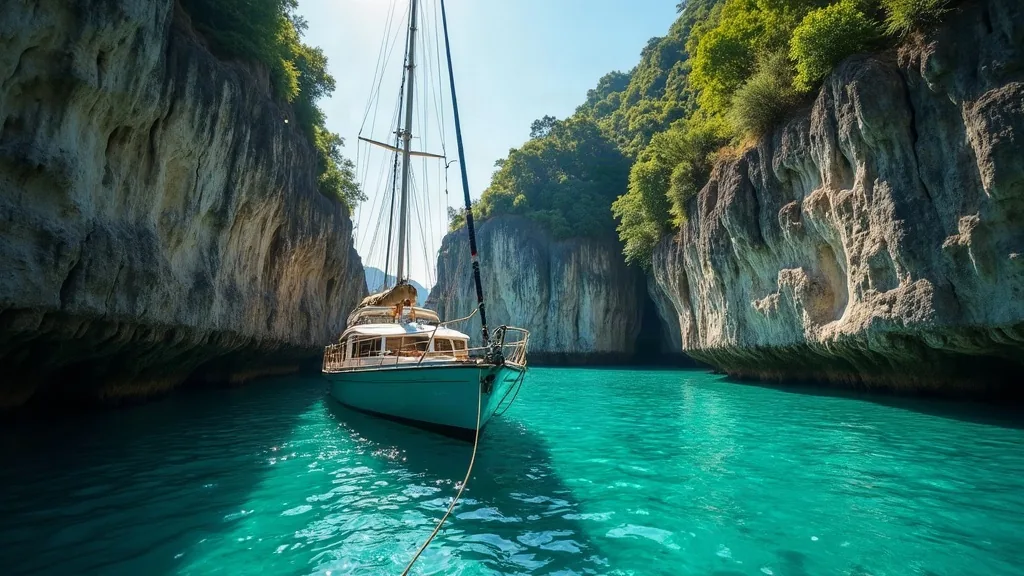
A stern line ashore is the right answer in a Raja Ampat karst bay only when the anchor is set in a genuine sand patch, the shoreline attachment does no damage, the bay is not subject to a local or conservation restriction, and the wind cannot come round behind you. Those four conditions together are less common than they look. Where any one fails, the seamanlike move is a different bay — and in this archipelago there is almost always a different bay.
Why the technique tempts you here
Raja Ampat’s geology produces exactly the bays that invite a line ashore: narrow karst inlets, sheer limestone walls, deep water close in and a thin shelf of workable depth. Swinging room is the scarce resource. A line ashore converts a bay you cannot swing in into a bay you can lie in, and it holds the vessel’s heading so the anchor loads consistently.
In the Mediterranean or the Adriatic this is routine. In a marine protected area with customary tenure over the shore, it is a decision with more inputs. As with everything in this region, the seamanship question and the conservation question are the same question — the anchorage page makes the same argument about ground tackle.
Condition one: the anchor still has to be right
A line ashore does not rescue a badly set anchor. It changes the direction of the load and it stops the vessel swinging, which means the anchor takes a steady pull instead of a varying one — but if the anchor is on coral or in a thin skim of sand over rock, it will still come out, and now the vessel pivots on a fixed stern point toward a wall.
So the sequence is unchanged: find the sand visually in good light, drop on it, back down and confirm the set, and only then run the line. If there is no sand, there is no anchorage, with or without a shore line.
Condition two: the shore attachment
This is where most damage is done. A line taken round a mangrove root, a young tree or a living coral outcrop damages it, and repeated use by successive vessels kills it. Karst limestone is sharp enough to saw through a line and brittle enough to break away under load.
Where a shore line is appropriate, use an existing fixed point if one has been installed, use a wide strop rather than the line itself round any natural feature, and choose solid rock over vegetation every time. Never use a mangrove — mangrove systems around Batanta and Salawati are nursery habitat and are exactly what the protected area framework exists to defend.
Condition three: permission and restriction
Most shoreline in Raja Ampat sits under customary tenure held by nearby villages, and the protected area network adds its own restrictions on top. A crew member going ashore to make a line fast is a crew member landing on someone’s ground.
Where there is a village within sight, ask. Where there is not, apply the same standard anyway: leave no fixture behind, cause no damage, and do not treat an uninhabited shore as unowned, because it very probably is not. The jetties and landings page goes into how shore access actually works here.
Condition four: the wind behind you
The failure mode that hurts is a night squall that arrives from the quarter you have your stern to. With a line ashore you cannot round up, you cannot pay out scope quickly, and you are held broadside or stern-to a wall in rising conditions with a tender in the water and a crew asleep.
Equatorial squalls arrive at any hour from any direction. That is the single strongest argument against making a shore line a routine technique in Raja Ampat rather than an occasional one. If the bay is only tenable while the wind stays in one sector, and you have removed your ability to respond to a shift, you have built a plan with no margin.
Rigging it so you can leave
If all four conditions hold, rig for a fast exit. Run the line so it can be slipped from on board — round the shore point and back to the vessel, not made fast ashore requiring someone to go and untie it. Keep a knife at the stern. Keep the engine available and the anchor windlass powered. Brief the crew on the recovery sequence before dark, not during the squall.
Float the line where a tender or a local longboat might run over it, and light it if there is any traffic. A submerged line across a bay is a genuine hazard to the village boats that use these waters daily, and being the yacht that fouled someone’s propeller is a poor way to build the relationships that make a season work.
The honest alternative
In practice, most vessels cruising Raja Ampat well use shore lines rarely. They pick conservation moorings where the tackle is sound and rated, they anchor in sand with proper swinging room where it is not, and they move rather than squeeze into a bay that only works with rigging. That is not timidity; it is recognition that the archipelago offers enough choice that you never have to accept a compromised anchorage.
If a specific bay on your plan looks like it needs a line ashore, send it to the desk before you commit the leg. Often the answer is that a better option lies twenty minutes away.
Frequently asked questions
Is taking a line ashore allowed in Raja Ampat?
There is no blanket prohibition, but shoreline in Raja Ampat is generally under customary tenure and parts of the archipelago carry conservation restrictions. Ask where there is a village, cause no damage to rock or vegetation, never use mangrove, and leave nothing behind.
What is the main risk of a stern line in a karst bay?
A night squall arriving from the quarter you have your stern to. With a line ashore the vessel cannot round up or pay out scope quickly, which removes your ability to respond to a wind shift in rising conditions.
Talk to the berthing desk
Raja Ampat rewards vessels that arrive with a plan. Share your LOA, draft, arrival window and intended islands, and we will answer with what is realistically available. Quotations in USD.