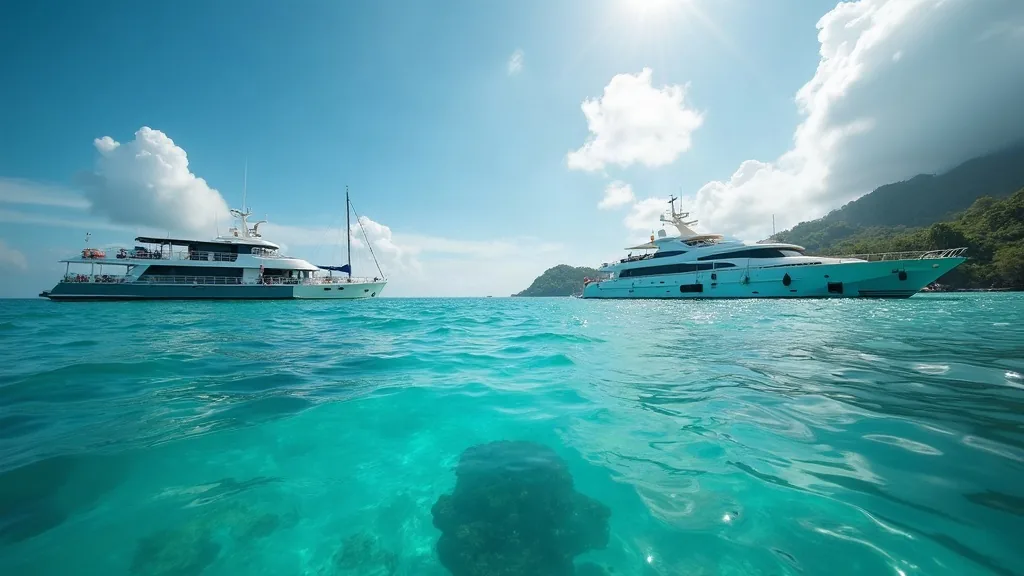
The working rule in Raja Ampat is that dive-site moorings belong to whoever needs them for diving at that time of day, and overnight use is a courtesy the fleet extends to vessels that do not abuse it. Do not raft onto a conservation buoy. Do not hold a site mooring through the morning dive window. Do not take the only rated buoy at a site if a heavier vessel needs it and you have anchoring options. The liveaboard operators here have decades of accumulated local knowledge, and how a visiting yacht behaves around buoys determines whether any of it is shared.
Who else is on the water
Raja Ampat’s most experienced mariners are not visiting yachtsmen. They are the skippers of the liveaboard fleet — phinisi and modern dive vessels running the same sites week in and week out, in every season, for years. They know which passage is fair at which state of tide, which buoy was replaced last month, which bay is untenable when the wind goes south, and which village to speak to about shore access.
They are also running a schedule. A liveaboard’s day is built around dive windows tied to tide and light, and those windows are not flexible. A visiting yacht occupying a site mooring at 0700 is not committing a crime, but it is costing a working vessel its morning, and that is remembered.
The timing convention
The convention that has emerged is simple and worth following. Dive-site moorings are in demand during dive windows — typically early morning, mid-morning, afternoon and at dusk for the specific sites that fish that way. Overnight use, arriving after the day’s diving and leaving before the morning window, is generally uncontroversial.
If you want a site during a dive window because your own guests are diving it, the answer is to say so on the radio and coordinate, not to occupy and hope. Operators are overwhelmingly reasonable about sharing when they are asked. They are much less reasonable about a yacht that treats a working buoy as a private berth.
Never raft on a conservation buoy
This one is absolute. The conservation moorings were engineered for a rated load, frequently a dive boat or a small liveaboard rather than a heavy yacht. Two vessels on one buoy multiplies the load and adds a snatch component as they range differently. It is the failure mode most likely to pull a fixing out of the substrate, and it does it over a reef.
If a site is full, go elsewhere. The archipelago is not short of water — see the anchorage page for how to choose an alternative properly.
Deferring on rating
Where a site has one heavy-rated buoy and several light ones, and a heavier vessel arrives, the seamanlike move is to give up the heavy buoy if you have a safe alternative. Your 20-metre hull may fit a light buoy or a sand anchorage; a 40-metre vessel may not have that option. Fleets that operate this way lose nothing, because the courtesy comes back.
The same applies to weather. If conditions deteriorate and a vessel with less capability needs the sheltered buoy, moving is the right call. This is not sentiment; it is the standard practice of any cruising community that operates far from assistance.
Radio discipline
Announce intentions. A short call before entering a site with vessels already on it — who you are, your length, what you intend, how long — resolves almost every potential conflict before it starts. Monitor the working channels the local fleet uses; ask an operator what those are on your first call rather than assuming.
Keep it short and keep it courteous. English is widely understood among liveaboard crews, but a few words of Indonesian go a long way, and the willingness to try is noticed more than the accuracy.
Tenders, divers and noise
Three things generate more friction than mooring occupation itself. Tenders running fast through a site with divers in the water is the serious one — surface marker buoys are not always visible, and a diver surfacing under a tender is a fatality. Slow down inside any site, post a lookout, and treat every float as a diver.
Generator and music noise carries across water at night far further than people on board believe. A yacht audible from a liveaboard four hundred metres away at 2300 has just annoyed thirty guests and a crew. And lighting: deck floods pointed outward wash out the sky and, at some sites, disturb the wildlife people came to see.
Why this is worth the effort
The practical return on good buoy etiquette in Raja Ampat is information, and information here is worth more than equipment. Operators who regard a visiting yacht as a good neighbour will tell you which mooring was re-rigged, which anchorage held in the last blow, which village to call for shore access, and where the mantas actually were this week rather than where the guidebook says.
They will also help if something goes wrong, and in a region with no yacht service industry, the nearest capable vessel is the nearest capable vessel. Being the yacht that took the buoy and blocked the morning dive is an expensive way to save twenty minutes.
A note on charter guests and the fleet
Private yachts sometimes arrive with an assumption that liveaboards are the tourist traffic and they are the discerning visitor. Reverse it. The liveaboard fleet includes vessels that have worked these reefs for twenty years with crews who grew up on this water, and their guests are frequently serious divers who have saved for years to be here. Behaving as though a site belongs to whoever has the larger hull is both wrong and, in a small archipelago, self-defeating.
The reciprocal courtesy runs both ways and generally does. Operators here are used to sharing water and will make room, coordinate windows and pass on information to a vessel that asks properly. Where a genuine conflict arises, resolve it on the radio between skippers rather than through guests or crew, and resolve it in favour of whoever has the operational need rather than whoever arrived first. That is the convention among vessels operating far from assistance everywhere in the world, and the reasons it exists — described further in spares, failures and isolation — apply here more than most places.
Frequently asked questions
Can two yachts raft on one mooring buoy in Raja Ampat?
No. Conservation moorings are engineered for a rated single-vessel load, and rafting multiplies that load while adding snatch as the vessels range differently. It is the failure mode most likely to pull a fixing out of the seabed, over a reef.
Do liveaboards have priority on Raja Ampat dive moorings?
There is no formal priority, but the working convention is that dive-site moorings belong to whoever needs them for diving during dive windows. Overnight use outside those windows is generally uncontroversial, and coordinating by radio resolves nearly every conflict.
Etiquette assumes the buoy is sound; verify that first — inspect a mooring buoy before trusting it.
Talk to the berthing desk
Raja Ampat rewards vessels that arrive with a plan. Share your LOA, draft, arrival window and intended islands, and we will answer with what is realistically available. Quotations in USD.