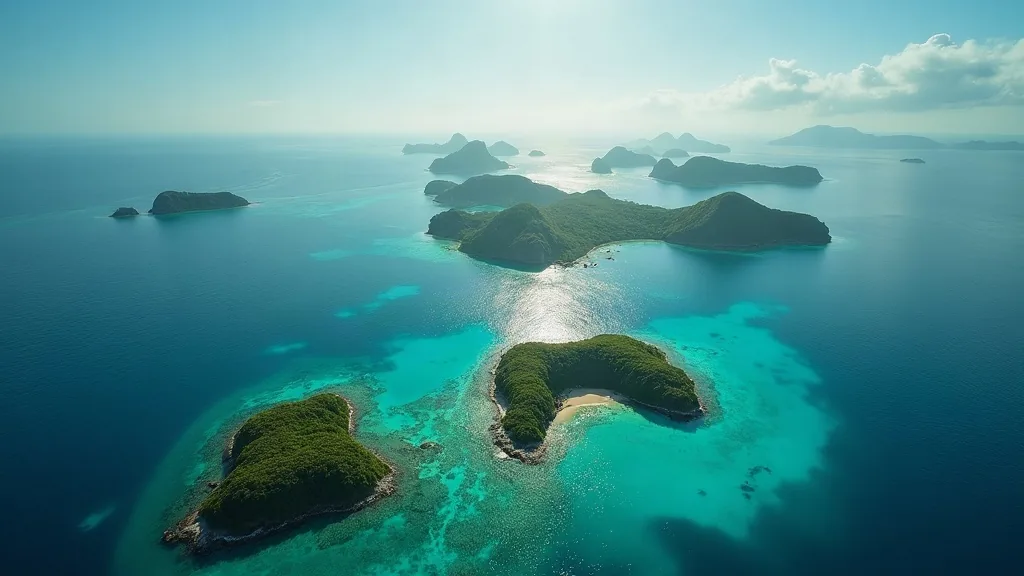
Raja Ampat has no superyacht marina because the demand is too dispersed to justify one, the protected-area framework discourages large coastal construction, and the supply chain that a marina would depend on sits two hours away in Sorong. What replaces it is a distributed system: a working harbour at Waisai for administration and crew, a conservation mooring network for the reef sites, hundreds of anchorages for everything else, and mainland logistics for fuel, parts and people. Vessels that understand this design cruise the region easily.
The demand is in the wrong shape
A marina is a fixed asset that earns money when boats sit still. Raja Ampat’s entire attraction is that boats move. The reef sites are spread across an area the size of a small country, and the difference between a good day and a mediocre one is frequently a two-hour reposition to a different island group.
Yachts that come here do not want a berth; they want to be on the water at the right site at the right state of tide. A marina at Waisai would be a car park that people drive past. The vessels with the most Raja Ampat experience — the liveaboard fleet — have converged on exactly the pattern this implies: moorings and anchors, with port calls only when there is a reason. Our berthing page sets out what that means hull by hull.
Building a marina here would damage what the marina is for
A superyacht marina needs dredged approaches, breakwaters, reclaimed land, fixed pontoons, shore power generation and a fuel installation. Every one of those items is an intervention in exactly the shallow-water coral environment that Raja Ampat is protected to preserve.
The regency is managed as a network of marine protected areas, with no-take zones, anchoring restrictions and a visitor contribution funding patrols and mooring maintenance. It is difficult to reconcile that framework with coastal construction of the scale a superyacht facility requires, and the political economy of the region — where communities hold customary rights over reefs and have used them to close areas to fishing — does not favour it either.
This is not an obstacle to overcome. It is the reason the water is worth crossing an ocean for.
The supply chain is on the mainland
Even if the will existed, a marina at Waisai would be a retail outlet with no warehouse behind it. Fuel in quantity comes through Sorong. Technicians, parts, medical capability and anything requiring a customs or immigration signature are Sorong functions. Provisioning beyond fresh local produce is Sorong at best and Makassar or Jakarta more realistically.
A marina depends on the density of a service industry around it, and that industry does not exist in the islands — see facilities and supply for what actually can and cannot be obtained. Building the berths without the industry would produce a facility that could take your lines and do nothing else.
What the distributed system looks like in use
| Marina function | How it is met in Raja Ampat |
|---|---|
| Secure overnight berth | Conservation mooring where rated and inspected; sand anchorage with verified swing otherwise |
| Crew and guest access | Waisai, via the Sorong ferry link; tender work everywhere else |
| Fuel | Sorong for volume; drummed small quantities at Waisai with lead time |
| Water | Vessel watermaker as primary; modest shore quantities as a bonus |
| Waste | Dry waste landed at Waisai by arrangement; the rest held for the mainland |
| Technical support | Flown in through Sorong; on-board spares and crew capability in the meantime |
| Local knowledge and shore access | Relationships with villages and dive operators |
The one thing the system cannot replace
A marina provides certainty. You book, you arrive, the berth is there. The distributed system provides options, not certainty, and that is the genuine trade-off. Mooring availability changes, harbour allocation at Waisai depends on the day’s ferry and patrol traffic, and weather closes exposed legs at short notice.
The correct response is not to wish for a marina but to build the itinerary with alternatives at every exposed point, which is what the cruising guide sets out. A Raja Ampat programme sold to guests as a fixed schedule will disappoint someone. The same programme sold as four zones, a standard of experience and a sequence decided on the water will not.
Will this change?
Marina development has been discussed for the region periodically, as it is for most attractive cruising grounds in Indonesia. Anyone planning a season should assume the current picture and confirm rather than plan around an announcement. Infrastructure timelines in remote eastern Indonesia are long, and the conservation and community considerations are substantive rather than procedural.
In the meantime, the distributed system works — and works better for the kind of cruising people come here to do. If you want the current picture applied to a specific vessel and window, send the details to the desk.
What a visiting owner should take from this
The absence of a marina is not a gap in the market waiting to be filled; it is a design that follows from the geography, the protection regime and the supply chain. Owners who arrive expecting to find one, or expecting one to appear next season, plan badly. Owners who accept the distributed system plan well, and they get something that no marina-based cruising ground can offer: an archipelago where the vessel is rarely within sight of another yacht and where the reef in front of the anchor is intact.
Practically, that acceptance shows up in three budget lines that a Mediterranean programme would not carry. Range and tankage, because fuel is a mainland function described in bunkering from Sorong. Self-sufficiency in spares and crew capability, because there is no service industry to fall back on — the inventory logic is in spares, failures and isolation. And time, because a plan without slack in it cannot absorb the weather that will inevitably move a leg. Budget those three properly and Raja Ampat is one of the easiest world-class cruising grounds to enjoy. Budget them as an afterthought and the missing marina becomes the explanation for a difficult fortnight, when the real cause was the plan.
Frequently asked questions
Will Raja Ampat get a superyacht marina?
Marina development is discussed periodically for the region, but conservation constraints, dispersed demand and the absence of a local supply industry all weigh against it. Plan a season on the current distributed system of moorings, anchorages and Sorong logistics, and confirm rather than plan around any announcement.
Where is the nearest full-service marina to Raja Ampat?
There is no full-service yacht marina in the immediate region. Sorong on the Papuan mainland provides the port, fuel and agency infrastructure that yachts depend on, but it is a commercial port rather than a yacht marina.
Talk to the berthing desk
Raja Ampat rewards vessels that arrive with a plan. Share your LOA, draft, arrival window and intended islands, and we will answer with what is realistically available. Quotations in USD.