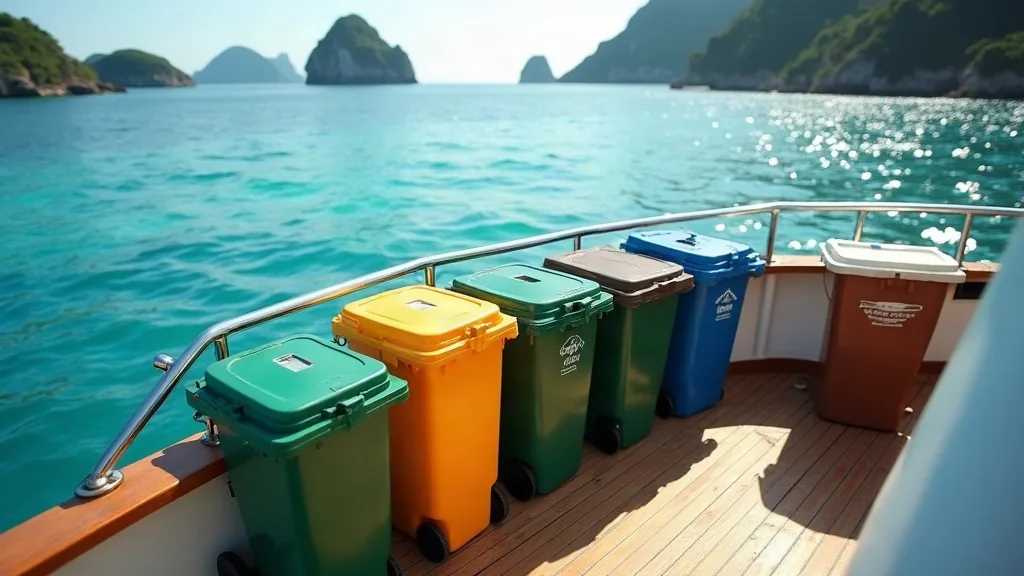
Assume Raja Ampat has no waste reception capability and plan to carry everything out. Reduce packaging before you arrive, segregate and compact aboard, land only what can genuinely be handled through a proper arrangement at Waisai, and hold the rest for the mainland. Black and grey water should be managed to the strictest interpretation of the rules, not the loosest. In a protected area whose entire value is water quality, this is not administration — it is the price of admission.
The infrastructure reality
There is no MARPOL-grade port reception facility in the Raja Ampat islands. The regency capital has municipal waste handling sized for a small town, not for visiting vessels, and the villages have essentially none. What looks to a visiting crew like a convenient bin is very often the start of a chain that ends on a beach or in a burn pile.
Handing bags to willing villagers is therefore not a solution even when it is offered graciously. It transfers a problem from a vessel with resources to a community without them, in the place least able to absorb it. The overall picture is on the facilities and supply page.
After handover the real work begins: vessel management for boats based this far east covers crew, maintenance cadence and charter operations.
Reduce before you arrive
The highest-leverage action happens in Sorong, before the vessel enters the region: strip packaging, decant into reusable containers, remove cardboard, consolidate. A thorough de-boxing session cuts the volume of waste generated over a two-week programme dramatically, and it is far easier to dispose of packaging in a mainland city than to carry it around a marine park.
The same logic applies to what you buy. Bulk over single-serve, glass and metal over multi-layer plastic, refillable over disposable. Water is the big one: a vessel making its own water and refilling bottles produces a fraction of the waste of a vessel buying cases of plastic. This is covered further in the piece on provisioning.
Segregate and compact aboard
| Stream | Handling |
|---|---|
| Food waste | Comminuted and discharged only where regulations permit and well offshore of reef and settlements; otherwise held. |
| Plastics | Never discharged. Compacted, stored, carried out. No exceptions anywhere at sea. |
| Glass and metal | Rinsed, crushed or nested, stored dry, carried out. |
| Paper and card | Minimised before arrival; stored dry and carried out. |
| Oily waste, filters, batteries | Hazardous. Held aboard in sealed containment for the mainland without exception. |
| Medical and sharps | Sealed containment, mainland disposal. |
Set up the segregation system before the season starts, label it, and brief the crew including any temporary crew. A system that depends on one person remembering fails in week two.
Black and grey water
This is where a yacht can do real harm invisibly. Raja Ampat’s reefs are close inshore, the anchorages are shallow, and the water exchange in an enclosed bay is much lower than the current in the passages might suggest.
Hold black water and discharge only in accordance with the applicable rules and well clear of reef, anchorages and settlements — and where holding capacity allows, hold it longer than the minimum. Grey water deserves more attention than it usually gets: use low-phosphate, biodegradable products throughout the vessel, because everything in the galley sink and the shower goes into the same water the guests are diving in a few hours later.
Sunscreen belongs in this conversation too. Reef-safer formulations without oxybenzone and octinoxate are widely available and worth specifying for guests as standard practice, alongside the conservation rules described on the entry and clearance page.
Landing what can be landed
Dry, segregated, non-hazardous waste can be landed at Waisai through a proper arrangement — meaning agreed in advance with someone who has the capacity and the responsibility to handle it, and normally with a payment that reflects the actual disposal cost. Arrange it, do not improvise it.
Everything else goes to the mainland. Build a call at Sorong into the programme at a point where the accumulated volume is manageable, which is generally the same call where you take fuel and stores.
Why the standard here is higher
Raja Ampat’s protection is not decorative. Communities have closed reefs to fishing, patrols enforce no-take zones, and visitors pay a contribution that funds the whole system. The reef quality that draws yachts across an ocean exists because of sustained local effort and real local sacrifice.
A visiting vessel’s contribution to that is almost entirely behavioural: anchor properly, moor properly, ask permission, and carry your waste out. It costs very little and it is noticed. Vessels that visibly operate to that standard are welcomed back, told where the mantas are, and given the local knowledge that makes the difference between a good season and an ordinary one — the same dynamic described on the access page.
Stowing it for two weeks without living with it
The practical objection crews raise is space and smell, and both are solvable with a system set up before the season rather than improvised in week one. Rinse everything that held food before it goes into storage — a rinsed tin is inert, an unrinsed one is not. Compact aggressively; a crusher or even a simple stamping routine reduces volume by most of itself. Store in sealed containers rather than open bags, and stow them somewhere ventilated and out of the sun rather than in a lazarette that reaches oven temperatures by midday.
Dry waste handled this way is genuinely unobtrusive for a two-week programme. Food waste is the part that cannot be stored, which is why the comminute-and-discharge rules matter and why menu planning that minimises it, as described in provisioning a yacht in Waisai, pays off twice.
Setting the standard with the crew
Systems fail when they depend on one person caring. Brief every crew member including temporary and delivery crew, label the containers unambiguously, and make it a standing order rather than a preference. Guests should be told too, briefly and without lecturing: in this marine park nothing goes over the side, and the reason is visible in the water they are about to swim in. Framed that way it is almost never resisted, and it sits naturally alongside the other conservation behaviours covered in manta season and wildlife distance.
Frequently asked questions
Where can yachts dispose of waste in Raja Ampat?
There is no MARPOL-grade reception facility. Dry, segregated, non-hazardous waste can be landed at Waisai through an arrangement agreed in advance with someone with the capacity to handle it. Hazardous waste, oily waste and everything else should be held aboard for the mainland.
Can I discharge grey water in Raja Ampat anchorages?
Anchorages here are shallow, close to reef and often poorly flushed, so grey water discharge deserves real caution. Use low-phosphate biodegradable products throughout the vessel, minimise discharge in enclosed bays, and manage black water to the strictest interpretation of the applicable rules.
Talk to the berthing desk
Raja Ampat rewards vessels that arrive with a plan. Share your LOA, draft, arrival window and intended islands, and we will answer with what is realistically available. Quotations in USD.