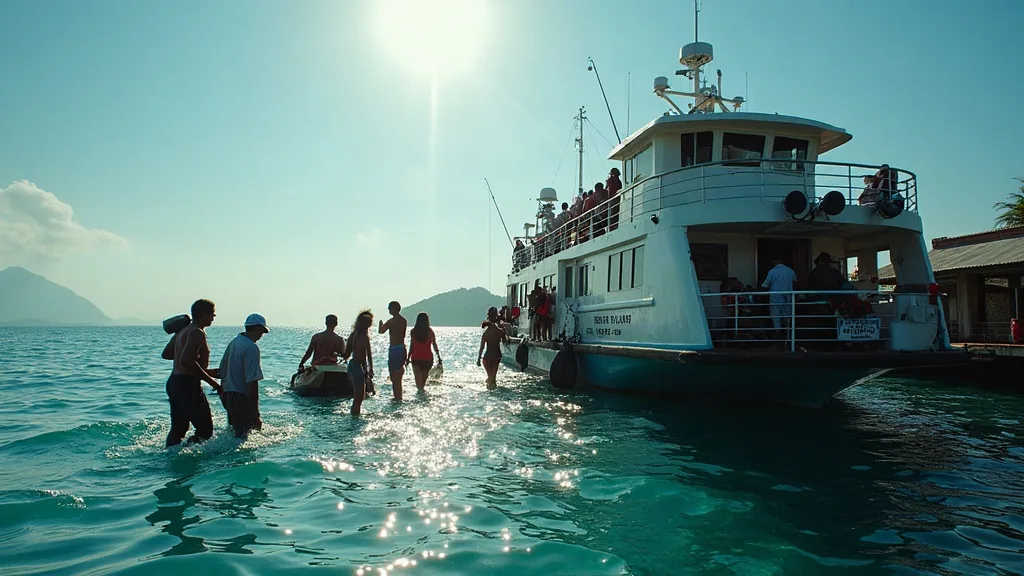
Every crew and guest movement in Raja Ampat runs through Sorong and the Waisai ferry, and both links can fail on a given day — so build at least one buffer day into every rotation and never schedule a joining crew member to arrive on the day the vessel departs. Flights into Sorong connect through hubs with their own delays, and the ferry crossing can be suspended in weather. A rotation plan with no slack will eventually cost someone a flight or leave the vessel short-handed for a leg.
The route everyone takes
There is one practical path in and out. International arrivals connect through a major Indonesian hub, then fly to Sorong. From Sorong the crossing to Waisai is roughly two hours by fast ferry, with slower services available. From Waisai the person joins the vessel, which is either alongside briefly, lying off, or working a nearby site with a tender coming in.
Each link in that chain has its own failure mode: a delayed or cancelled connecting flight, a missed ferry, a ferry suspended for weather, or a vessel that cannot get to Waisai because the leg it is on has changed with the conditions.
Where the buffer goes
| Movement | Minimum buffer | Why |
|---|---|---|
| Joining crew or guest | One night in Sorong before the crossing | Absorbs a delayed connecting flight without missing the ferry. |
| Departing crew or guest | One night in Sorong before the flight | Absorbs a weather-suspended ferry without missing an international connection. |
| Charter changeover | A full day at the Waisai end | Absorbs the vessel being delayed by weather on the inbound leg. |
| Critical technician or part | Two days | Freight and specialist travel both slip, and the vessel is usually waiting. |
The buffer night in Sorong is the highest-value item on this list and it is the one people cut to save a hotel bill. The saving is trivial against the cost of a missed international flight or a vessel departing a leg one crew member short.
Schedule rotations where the itinerary already goes
The hub-and-spoke structure described in the cruising guide exists partly for this reason. Because guests and crew arrive through Waisai, the natural shape of a programme is core-zone work, one expedition leg, and a return to the core zone — with changeovers falling where the vessel has a reason to be near Waisai anyway.
Fighting that shape is expensive. A rotation scheduled while the vessel is at Misool or in the northern islands means abandoning the leg, steaming back, and steaming out again, burning fuel that the plan described in the bunkering piece may not have allowed for.
Documentation and visas
Crew and guests need visas that actually cover the period they will be aboard, and joining crew for a foreign-flagged vessel should have their status handled properly rather than improvised on arrival. Indonesia treats crew and tourist status differently, and getting it wrong is a problem that surfaces at the worst moment.
This is agent work. The same Sorong agent handling the vessel’s clearance, described on the entry and clearance page, should be told about every crew movement well in advance. Also remember the marine park entry contribution applies per person, so arriving guests need it arranged too.
Briefing people who have never been anywhere like this
Guests and new crew frequently arrive with expectations formed by Bali or the Mediterranean. A short honest briefing before travel prevents most disappointment: the flight is long and connects, Sorong is a working port city rather than a resort, the ferry is a ferry, connectivity is limited once the vessel leaves the core zone, and the medical and evacuation picture is what it is.
Pack guidance matters more than usual. Reef-safe sunscreen, proper footwear for sharp limestone landings, personal medication in sufficient quantity because a pharmacy is not nearby, and soft bags rather than hard cases because everything transfers by tender.
When it goes wrong anyway
Sometimes the ferry does not run and a guest is stuck in Sorong overnight. The vessel’s response should be planned in advance rather than invented: who meets them, where they stay, who is paying, and whether the vessel waits or repositions. Having that answer ready turns a stressful evening into a minor administrative event.
Where the desk is coordinating a programme, this contingency is part of what is arranged, and third-party costs are quoted in United States dollars. Send the rotation dates with the itinerary and they can be sanity-checked against the shape of the season before anyone books a flight.
Handover quality, not just headcount
A rotation that gets a body aboard on the right day but transfers no knowledge is a rotation that costs the vessel a week. In a cruising ground with no support, the departing crew member’s understanding of the vessel’s current state — what is running warm, which pump is temperamental, where the spares actually are, which villages have been visited and who was spoken to — is genuinely operational information.
Build overlap into the schedule wherever the budget allows: one day aboard together is worth more than any written handover. Where overlap is impossible, require a written handover covering vessel state, outstanding defects, stores levels and the relationships established, and have the incoming crew read it before they leave Sorong rather than on the tender. The defect-list discipline this supports is described in spares, failures and isolation.
Arriving crew and the first 48 hours
New crew arrive tired, dehydrated and hot after a long connection, and they are frequently thrown straight into tender operations in strong current. That is a poor combination. Give them a night before anything consequential, brief them properly on the tender rules that matter in these passages — covered in reading tidal stream — and do not let a jet-lagged newcomer take a tender ashore alone on their first afternoon.
Frequently asked questions
How do crew get to a yacht in Raja Ampat?
By flying into Sorong on the Papuan mainland, then crossing to Waisai by ferry, roughly two hours on the fast service. From Waisai they join the vessel, which is either briefly alongside, lying off, or working a nearby site with a tender coming in.
How much buffer should I allow for a Raja Ampat crew change?
At least one night in Sorong on each side — before the crossing for joiners and before the flight for leavers — and a full day at the Waisai end for a charter changeover. Both the connecting flights and the ferry can fail on a given day.
Talk to the berthing desk
Raja Ampat rewards vessels that arrive with a plan. Share your LOA, draft, arrival window and intended islands, and we will answer with what is realistically available. Quotations in USD.