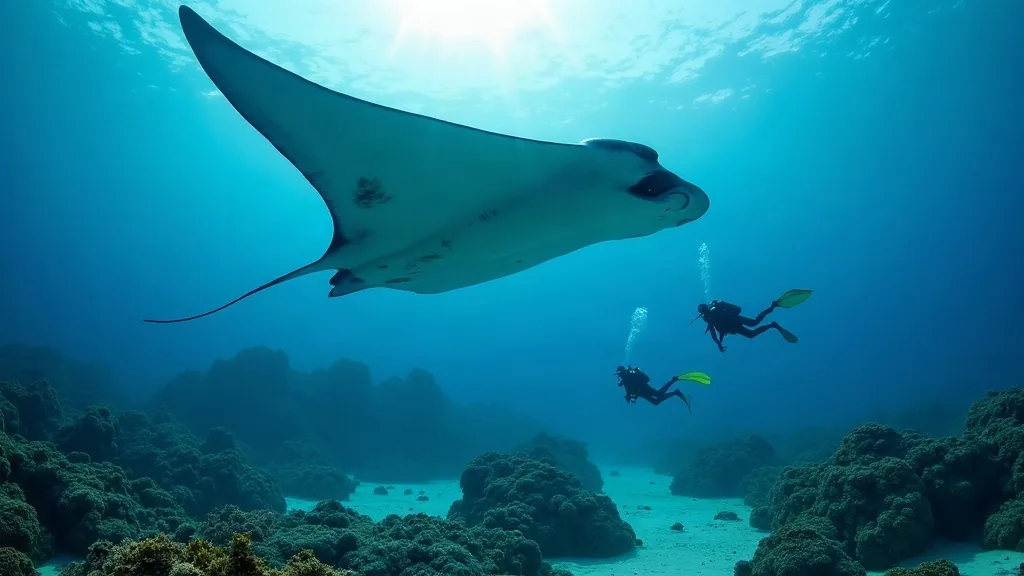
Manta rays are protected in Indonesian waters, and the cleaning stations where they aggregate in Raja Ampat are managed sites with behaviour rules that visiting yachts are expected to follow. Keep tenders slow and clear, never approach or chase from above, stay low and still as a diver, and do not touch. Aggregation varies with plankton, season and site, so the honest answer to “when will we see mantas” is that the odds are good in the right window at the right site — not that it is guaranteed.
Why Raja Ampat holds mantas
The same current-driven nutrient flow that builds the reef, described in the piece on the Dampier Strait, supports the plankton that mantas feed on. Where topography concentrates that flow, mantas feed. Where reef structure hosts the cleaner wrasse that service them, mantas gather to be cleaned — and those cleaning stations are the reliable, repeatable sites.
Both reef mantas and the larger oceanic species occur in the region. Indonesia has protected mantas nationally, and Raja Ampat’s local management adds site-level rules on top. The commercial logic is unambiguous: a living manta visited repeatedly by paying divers is worth vastly more over its life than a dead one, and the region’s protection reflects that.
Timing and honesty with guests
Aggregation is driven by plankton, which is driven by season, current and conditions, and it varies year to year and site to site. There are windows when the odds at particular sites are very good and windows when they are poor. Local operators track this closely and their current information is worth more than any published seasonal chart.
The correct thing to tell guests is that the vessel will be at the right sites at the right state of tide during a period when the odds are good, and that these are wild animals. Guests told this are thrilled when it happens. Guests promised mantas feel cheated by an otherwise outstanding week. The same principle applies to the whole itinerary, as described in the cruising guide.
Tender behaviour
| Do | Do not |
|---|---|
| Approach the site slowly and stop well clear | Drive over animals or between them and the reef |
| Drop divers away from the animals and let them approach the site underwater | Drop divers directly on top of a manta |
| Keep the engine off or in neutral while people are in the water | Manoeuvre repeatedly around swimmers and animals |
| Post a lookout for surface markers and snorkellers | Assume you can see everyone |
| Use a mooring where one exists | Anchor on the reef at a cleaning station |
Anchoring deserves emphasis. Cleaning stations are reef features, and dropping ground tackle on one damages the exact structure that brings the animals in. Where a conservation mooring is provided, that is why.
In-water behaviour
The core rules are consistent across responsible operators worldwide. Stay low and still on the reef, out of the cleaning station itself, and let the animals come to you — they routinely do, and the encounters are better for it. Do not swim at, chase, or position yourself above a manta; approaching from above reads as predatory and moves them off.
Do not touch, ever. Mantas carry a protective mucus layer that human contact damages. Do not block their path along the reef or over the station. Control bubbles where you can, since a burst of exhaust directly beneath an animal will move it.
Snorkellers should stay at the surface and out of the descent path, not free-dive down onto the station. Cameras change people’s behaviour more than anything else on this list — brief guests that the shot is not worth displacing the animal, because everyone else on the site loses the encounter too.
Other megafauna
The same principles cover the rest of what Raja Ampat offers: reef sharks, wobbegongs, turtles, dugong in some seagrass areas, and cetaceans in passage. Do not chase, do not corner, do not touch, do not feed. With cetaceans, keep a substantial distance, never place the vessel or a tender in their path, and let them make the choice.
Turtle nesting beaches occur in the archipelago and are sensitive: no lights on nesting beaches at night, no vehicles or crowding, and no disturbance of nests or hatchlings. Ask locally before landing on any beach that might be a nesting site, which also fits the access etiquette described on the customary tenure page.
Why the standard is enforced
Raja Ampat’s protection is not nominal. Patrols operate, communities watch, and the operators who work these sites daily have a strong commercial and personal interest in visitors behaving. A yacht that harasses wildlife at a cleaning station will be reported by the dive boat alongside it, and that report will follow the vessel around a very small archipelago.
Behaving well costs nothing, produces better encounters, and keeps the door open. That is the whole calculation.
Briefing guests before the tender leaves
Almost every wildlife incident at a cleaning station comes from a guest acting on instinct rather than malice — swimming toward an animal, diving down for a photograph, or reaching out. Instinct is what a briefing exists to override, and the briefing has to happen before people are in the water and excited, not while they are.
Keep it short and concrete: stay low, stay still, let them come, never above, never touch, no chasing for a photograph. Explain the reason rather than only the rule — that approaching from above reads as predatory and moves the animal off, costing everyone on the site the encounter. Guests who understand why comply willingly; guests given a list of prohibitions comply until they are excited.
Recording sightings usefully
Manta populations here are studied through photographic identification of the individual belly patterns, and visiting vessels are in a position to contribute genuinely useful data almost for free. A clear ventral photograph with a date and a site, passed to the operators or researchers working the area, adds to a long-running record.
It also gives a visiting yacht something to offer the local community of operators beyond good manners, which is worth more here than it might appear — the reciprocity that follows is the same one described in customary reef tenure and in buoy etiquette.
Frequently asked questions
When is manta season in Raja Ampat?
Aggregation is driven by plankton availability, current and site conditions, and it varies year to year rather than following a fixed calendar. Local operators track current activity closely, and their information at the time of the visit is more reliable than any published seasonal chart.
Are mantas protected in Raja Ampat?
Yes. Mantas are protected in Indonesian waters, and Raja Ampat’s local management adds site-level behaviour rules at cleaning stations. Approaching from above, chasing, touching and anchoring on cleaning-station reef are all unacceptable.
The behaviour rules at manta sites sit on top of a longer story of local ownership — see customary reef tenure in Raja Ampat.
Talk to the berthing desk
Raja Ampat rewards vessels that arrive with a plan. Share your LOA, draft, arrival window and intended islands, and we will answer with what is realistically available. Quotations in USD.