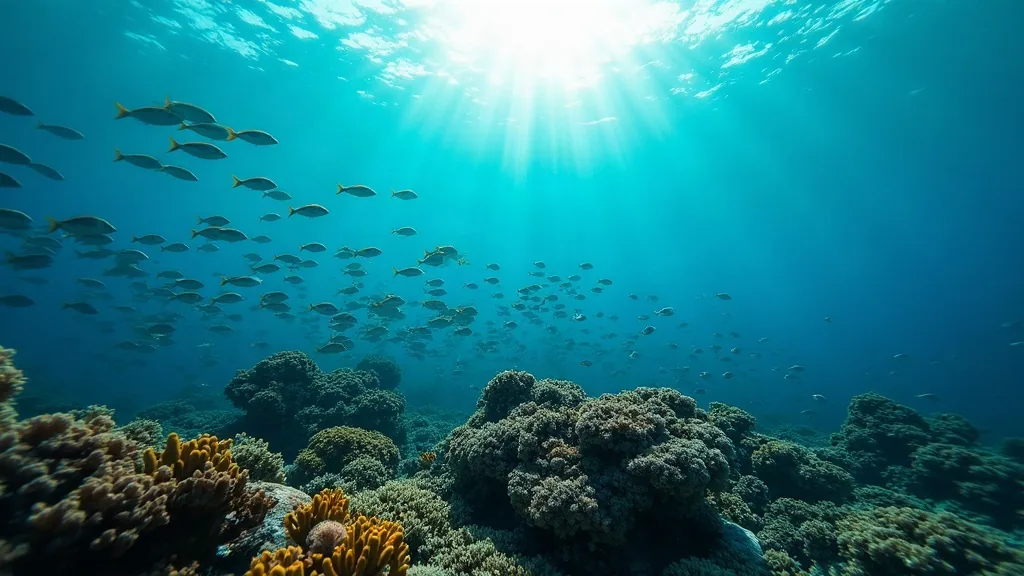
The Dampier Strait’s reefs are exceptional because water moves through the strait in volume, and that moving water is also the main operational constraint on a yacht working there. Current feeds the filter-feeding organisms that build the reef structure, which feeds everything above them. It also decides when a site can be dived, which direction a vessel lies at anchor or on a mooring, and whether a tender can get back. Plan the day around the tide and the strait is straightforward; ignore it and nothing works.
The mechanism
The strait separates Waigeo from Batanta, and it is a relatively narrow gap between substantial bodies of water. Every tide, a large volume has to pass through a constricted opening, and it accelerates to do so. Around headlands, over ridges and through the gaps between the smaller islands within the strait, that flow speeds up further and generates upwellings, eddies and shear lines.
Nutrient-rich water moving fast is exactly what soft corals, sea fans, crinoids and other filter feeders need. They colonise the ridges and drop-offs where the flow is strongest, they build dense three-dimensional structure, and that structure shelters and feeds the reef fish. The schools attract the predators. The whole spectacle exists because of the current.
What it means for diving
Sites in the strait are tide-dependent, not merely tide-affected. Each has a window — often around a slack or a particular direction of flow — when it is diveable at the standard a guest expects, and outside that window it is either a drift for experienced divers or simply not on.
This has a direct scheduling consequence: the day is built around the tide table, and the guest programme has to bend to it. Breakfast moves. The afternoon dive is at an odd hour. A site everyone wants is dived on the third day because that is when the window falls. Charter guests who understand this in advance accept it easily; those who were promised a fixed daily rhythm do not.
It also means local knowledge is worth a great deal. Dive operators working these sites weekly know the windows precisely, and the relationship-building described in the piece on buoy etiquette is how a visiting yacht gets access to that knowledge.
What it means for the vessel
Vessels in the strait frequently lie to stream rather than wind. That changes the approach to a mooring, it changes the swinging circle, and it reverses both roughly every six hours. The technique is covered in the piece on reading tidal stream before picking up a mooring, and the same arithmetic applies to ground tackle, as set out on the anchorage page.
For anchoring specifically, the strait’s sites are often steep-to with limited sand, which is why the mooring network is concentrated here. Where a rated and inspected buoy exists, it is usually the better choice.
Tender operations are the real risk
The most common way a day in the Dampier Strait goes wrong is a tender that cannot make headway home. A small outboard against a running stream in a constriction makes no ground at all, and the crew in it may not appreciate how quickly they are losing the vessel.
The rules that prevent this are simple and should be standing orders: tender movements are planned around the tide, the return window is tied to the state of tide rather than the clock, every tender carries a handheld radio and spare fuel, someone aboard always knows where the tender went and when it is due, and a tender never leaves at the start of a building stream on a long run.
The same applies to divers. Surface marker buoys, a proper pickup plan and a tender that stays with the group are basic here, not cautious.
Where a yacht positions itself
The strait is the core of a Raja Ampat programme for good reason: it holds the highest density of quality sites, it is closest to Waisai for crew and stores, and it has the shortest logistics tail back to Sorong. Vessels with limited range do a strait-and-Batanta season and do it extremely well.
The practical pattern is to base loosely within the strait, move short distances between sites according to the tide, and return toward Waisai when the itinerary needs stores or a changeover — the hub-and-spoke shape described in the cruising guide.
Traffic
The strait is busy by Raja Ampat standards. Liveaboards, dive boats, village longboats, cargo craft and the Sorong–Waisai ferry all use it. Local boats do not always carry lights, some are small and low in the water, and fishing gear and floats are set in places that are inconvenient for a vessel under way.
Keep a proper lookout, avoid night transits where you can, and give small craft a wide margin. In a place where the nearest capable assistance is often another visiting vessel, defensive navigation is not pessimism.
Why it is worth the discipline
Once a crew has internalised the tide, the Dampier Strait becomes the easiest world-class cruising ground imaginable: short hops, dense sites, reliable logistics and diving that people spend years planning to see. The discipline is not onerous. It is one table, consulted every morning, driving every decision for the day.
Working the strait across a week
Because each site has its own window, a productive week in the strait looks less like a tour and more like a rota: the tide table is read at breakfast, the day’s two or three sites are chosen to fit the windows, and the vessel moves short distances between them. Sites that everyone wants may not fall favourably until midweek, which is why the itinerary is written as a set of intentions rather than a schedule.
This has a pleasant side effect. Because the fleet is all reading the same tide table, vessels naturally spread across sites rather than converging on one, and the strait feels less busy than the number of hulls would suggest. Coordinating by radio, as described in buoy etiquette, makes that spread work even better.
Conditions underwater
Guests should be briefed honestly that current is the point rather than an inconvenience, and that the diving here rewards technique over enthusiasm — staying low, using the reef for shelter, moving with the flow rather than across it, and carrying a surface marker as standard. Sites are frequently better with some current running than at slack, so the goal is the right amount rather than none. Wildlife behaviour rules apply throughout and are covered in manta season and wildlife distance.
Frequently asked questions
Why is the diving so good in the Dampier Strait?
Strong tidal flow through a constricted strait delivers nutrient-rich water at speed, which feeds the filter-feeding corals and fans that build dense reef structure. That structure shelters and feeds reef fish, which in turn attract larger predators. The current is the cause of the abundance.
Can beginners dive the Dampier Strait?
Many sites are tide-dependent and can run strong, so site selection and timing matter enormously. Within the right window there are sites suitable for less experienced divers, but the schedule must follow the tide rather than the guest’s preferred hour.
Talk to the berthing desk
Raja Ampat rewards vessels that arrive with a plan. Share your LOA, draft, arrival window and intended islands, and we will answer with what is realistically available. Quotations in USD.